
Scalable, Flexible Performance Testing
BlazeMeter + Jenkins brings superior performance and reliability to your CI/CD pipeline by enabling faster, automated, and data-driven releases.

Faster Deliveries
Frequent, automated delivery of smaller code changes enables faster, bug-free releases. BlazeMeter helps you deliver what customers need now (not what they needed a year ago) and stay agile.

Higher Code Quality
Automated early and parallel testing catches bugs earlier in development and before deployment. Avoid last-minute code patching, bug fixes, and achieve continuous optimization.

Continuous Feedback
Fail fast, fix faster. Immediate feedback speeds up remediation, shortens cycles, and catches bugs before they reach users.

Efficient Testing
Remove the testing bottleneck. Orchestrate all tests as part of an automated pipeline to get complete coverage and ensure code quality. Testing just became easy.
Become a Performance Testing Master
Upgrade your CI/CD skillset with BlazeMeter's free courses in BlazeMeter University. Welcome to the fast track for building faster, smarter, and more resilient applications.
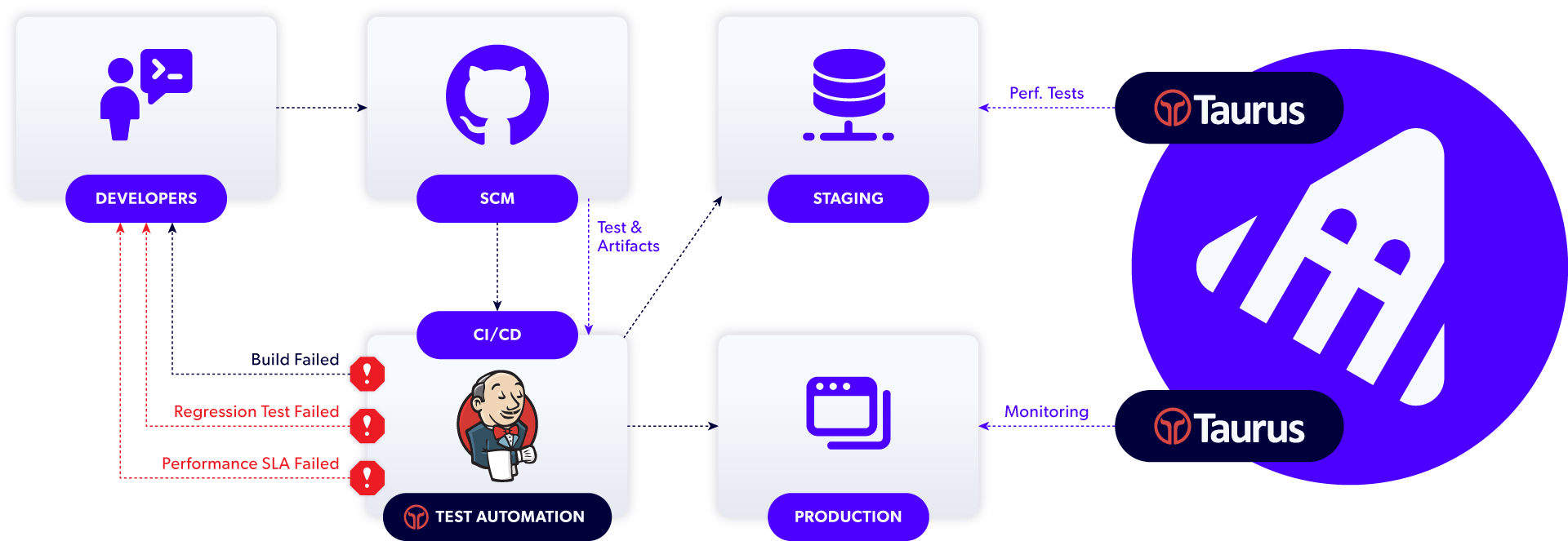
Continuous Testing with Jenkins CI/CD
Continuous testing is an essential part of the agile development cycle. BlazeMeter is compatible with CI tools like open source Jenkins or TeamCity.
1. Create Your Performance Tests
- Create test scripts in JMeter.
- Scale them in BlazeMeter to find bottlenecks.
- Create tests for daily scenarios, edge cases, and unexpected traffic spikes.
- Missing test data? Use BlazeMeter Test Data.
2. Automate Tests with Jenkins
- Schedule tests to run automatically with every build.
- Run thousands of tests in parallel every day.
- Integrate load and performance tests into your CI/CD.
- Catch issues before production and to achieve agility.
3. Accelerate, Streamline, Release
- Execute locally before deploying into your CI/CD pipeline.
- Get alerted about fails faster and fix faster.
- Release with higher quality and increased confidence.
- Achieve true continuous testing and optimize your code by testing on time.
Introducing the Jenkins Plugin
Use BlazeMeter’s Jenkins Plugin to automatically run your load test scripts into Jenkins and analyze the reports in Jenkins. You can also set the final Build status as good, unstable or failed, based on the reported error percentage and response times KPIs.
3 Ways to Use Jenkins for Load and Performance Testing
- Load Test Automation - Leverage Jenkins to automate your test executions instead of manually running them.
- Continuous Integration - Trigger test runs based on your needs, like after every build or every night.
- Jenkins With Taurus - Manage your tests easily in Jenkins with open source Taurus. Create a single, simple config and manage all test runs in one place.
Experience Faster Releases & Improved Code Quality ByIntegrating BlazeMeter With Jenkins.
Frequently Asked Questions
Jenkins performance testing integrates performance tests into a Jenkins CI/CD pipeline so teams can automatically evaluate application performance as part of the development process. With BlazeMeter and Jenkins, teams can automate load and performance tests, receive fast feedback, identify bottlenecks earlier, and improve release quality.
You can run performance tests in Jenkins by integrating a performance testing solution such as BlazeMeter into your CI/CD workflow. BlazeMeter's Jenkins Plugin lets teams automatically run load test scripts and analyze test reports in Jenkins, while tests can be triggered according to pipeline needs, including after builds or on a nightly basis.
BlazeMeter integrates with Jenkins through the BlazeMeter Jenkins Plugin, allowing teams to incorporate automated load and performance testing into Jenkins workflows. Teams can run BlazeMeter load test scripts, analyze reports in Jenkins, and set build status to good, unstable, or failed based on error percentage and response-time KPIs.
Yes. BlazeMeter supports a workflow where teams create performance test scripts in JMeter, scale those tests in BlazeMeter, and automate their execution with Jenkins. This enables JMeter performance testing to become part of an automated CI/CD pipeline rather than a separate manual testing process.
Integrating performance testing into Jenkins helps teams test earlier and receive continuous feedback during development. BlazeMeter highlights benefits including catching issues before production, faster remediation, improved code quality, shorter testing cycles, and greater confidence when releasing software.
BlazeMeter's Jenkins Plugin can set the final Jenkins build status to good, unstable, or failed based on error percentages and response-time KPIs reported by the test. This helps teams incorporate performance criteria directly into automated CI/CD workflows.
BlazeMeter supports continuous testing with Jenkins by integrating load and performance tests into automated CI/CD workflows. Teams can create JMeter tests, scale them with BlazeMeter, automate execution through Jenkins, and use test feedback to find performance issues before deployment.